
DJC#015 – Breathe and S.T.O.P.: Help Calm Yourself…And Your Child
Here’s a little riddle for you. What are you born with that stays with you until you die? Your breath. We go through life breathing every few seconds and for most of us, it’s second nature. According to the American Lung Association we take around 20,000 breaths a day or about 7.5 million breaths per year! Breathing is at the core of our human system, yet most of us do not realize how helpful it can be to understand it better. Now there is a whole science dedicated to our lungs (respiratory physiology), which sounds like an interesting read. Sorry to disappoint, but you won’t find anything about that here.
We don’t even realize we’re doing it half the time. Unless we’re exerting ourselves playing a pickup game of hoops where we think we’re still that athlete we were in high school. Or even worse, we just walked up a flight of stairs and now we’re out of breath. It is true that after 35 our lung capacity slowly declines so if you’re lucky enough to be that old (and wise hopefully), you can always chalk it up to age to make you feel better.
Just as your breathing can increase, it can also decrease. Ever notice your child(ren) when they’re having a good cry and they eventually have to catch their breath in order to stop? That’s that’s their body’s natural way of calming itself. But what about if they knew how to do this on their own…and without crying? What about if you are getting stressed out or frustrated? Wouldn’t it be great if you could do something about it?
I’m going to share with you two breathing techniques that can help you both the next time either of you find yourselves in one of those precarious situations.
Box Breathing
Has someone ever said to you, “Take a deep breath, dude.”? It’s something you’ve probably heard many times over the course of your life in one way or another. But have you ever stopped and thought about what it means? What the action of taking a deep breath does? Now let’s 4x that deep breath with a technique called box breathing.
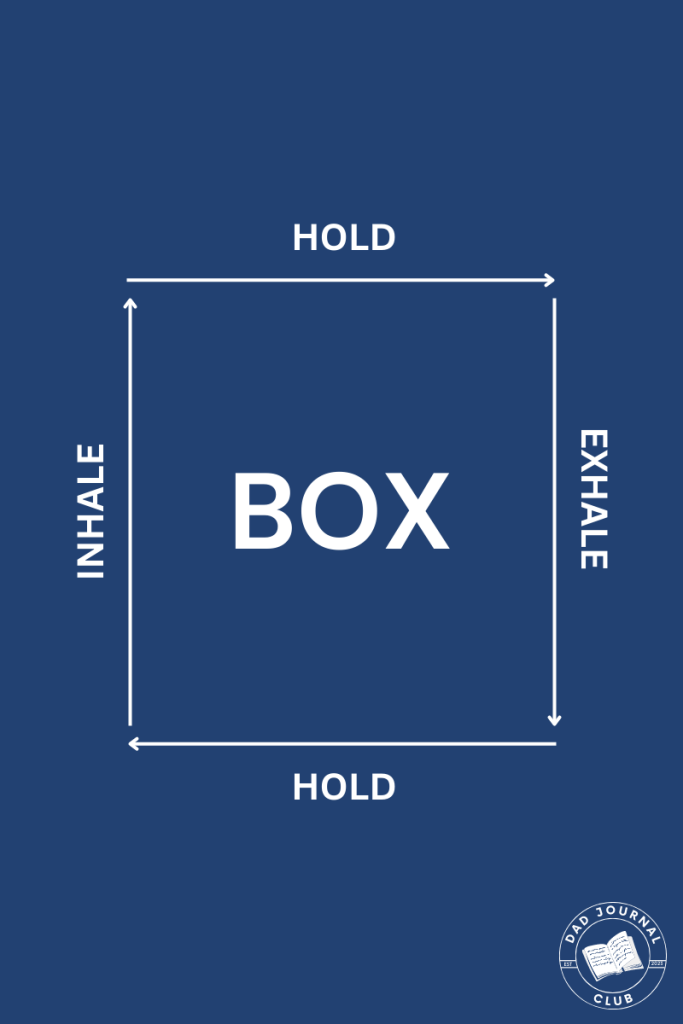
Box breathing has been around for ages, and it has been incorporated into many spaces – yoga, mindfulness and the military. The technique (also known as four-square breathing) itself is a simple and effective way to regulate breathing and promote relaxation. It’s very easy to do and teach your child. You take a deep breath in for four seconds, hold it for four seconds, exhale for four seconds, and hold for four seconds before starting again.
This is a simple yet effective way for you to take a beat while you take a breath or two. Close your eyes while you do it for an even calmer effect. Feel your heart rate slowing down and notice your anxiety settling. It can give you that moment you need, and you can use this anytime and anywhere. Now let’s incorporate box breathing with the next technique.
S.T.O.P.
Have you ever seen your child(ren) get so frustrated that it turns into a tantrum? Have you ever gotten so frustrated you yell obscenities and throw something across the room (guilty for sure)? If the answer is yes to either of these, then you’ll want to S.T.O.P.
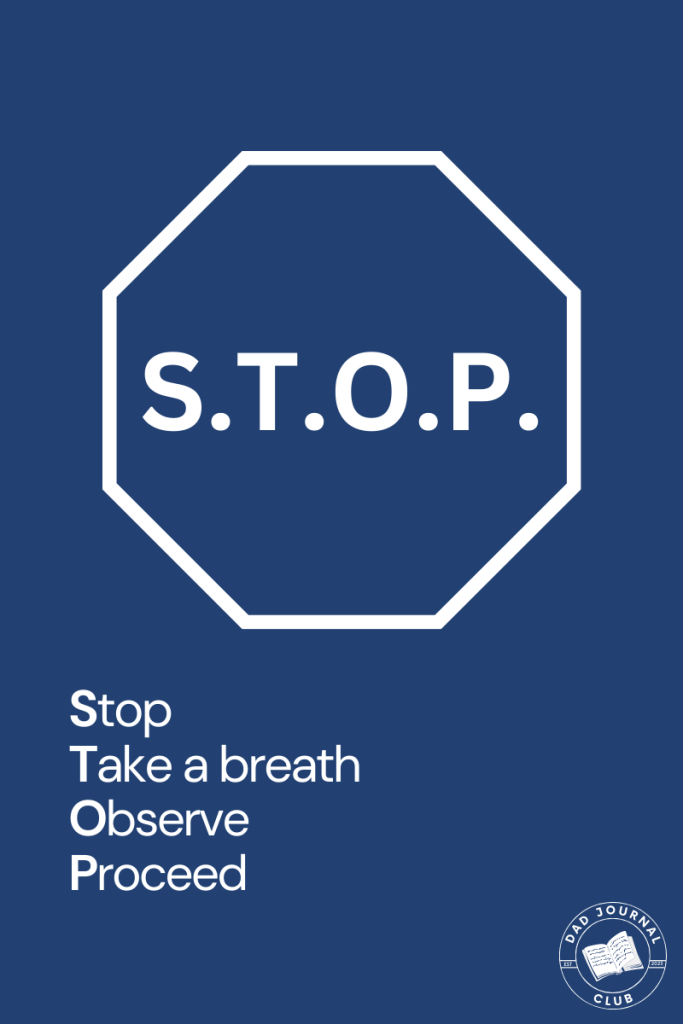
S.T.O.P. stands for Stop, Take a breath, Observe, Proceed. Becoming aware of our emotions is easier said than done. It’s also something we as adults can do a heck of a lot better than our children. It’s not their fault…their brains are still developing (until they’re 25 by the way so cut them some slack). Once you are aware, then you can address the issue.
By stopping, we’re actually starting towards calmness. Stopping the action that’s frustrating us, or stopping from crying, is necessary in order to take the next step. Taking a couple deep breaths (remember box breathing) will help slow down your heart rate and focus on your breath, which in turn takes away the attention of the issue. Observing what you are feeling will make you aware of what emotions you are experiencing. Think about the words to describe your feelings and take it one step further to ask yourself why you’re feeling this. Finally, proceeding on with your activity or something else with a calmer mind.
Share this with your child(ren) and next time they could use it, step in and walk them through it step-by-step. Now if they don’t react well and hit you up side the head, remember, I’m just sharing information. Also, watch this Headspace/Star Wars collab video series on YouTube together with them, and you’ll both learn and be entertained. This is where my son and I learned all about S.T.O.P. and revisit it from time to time.
Put Your Oxygen Mask On First
Just like the flight attendant tells us before takeoff, we have to learn to S.T.O.P. ourselves before we can help our kids. If you’re not calm, then there’s no way they’ll become calm. Start with these two basic techniques and incorporate them into your daily life when you’re challenged and need to regroup. Write them down so you won’t forget. Write in your journal about the times you use these techniques and track their effectiveness. Share them with your child(ren) and practice with them – before they actually need them. So then when it’s time, they know exactly what to do.
 Dad Journal Club
Leave a comment